
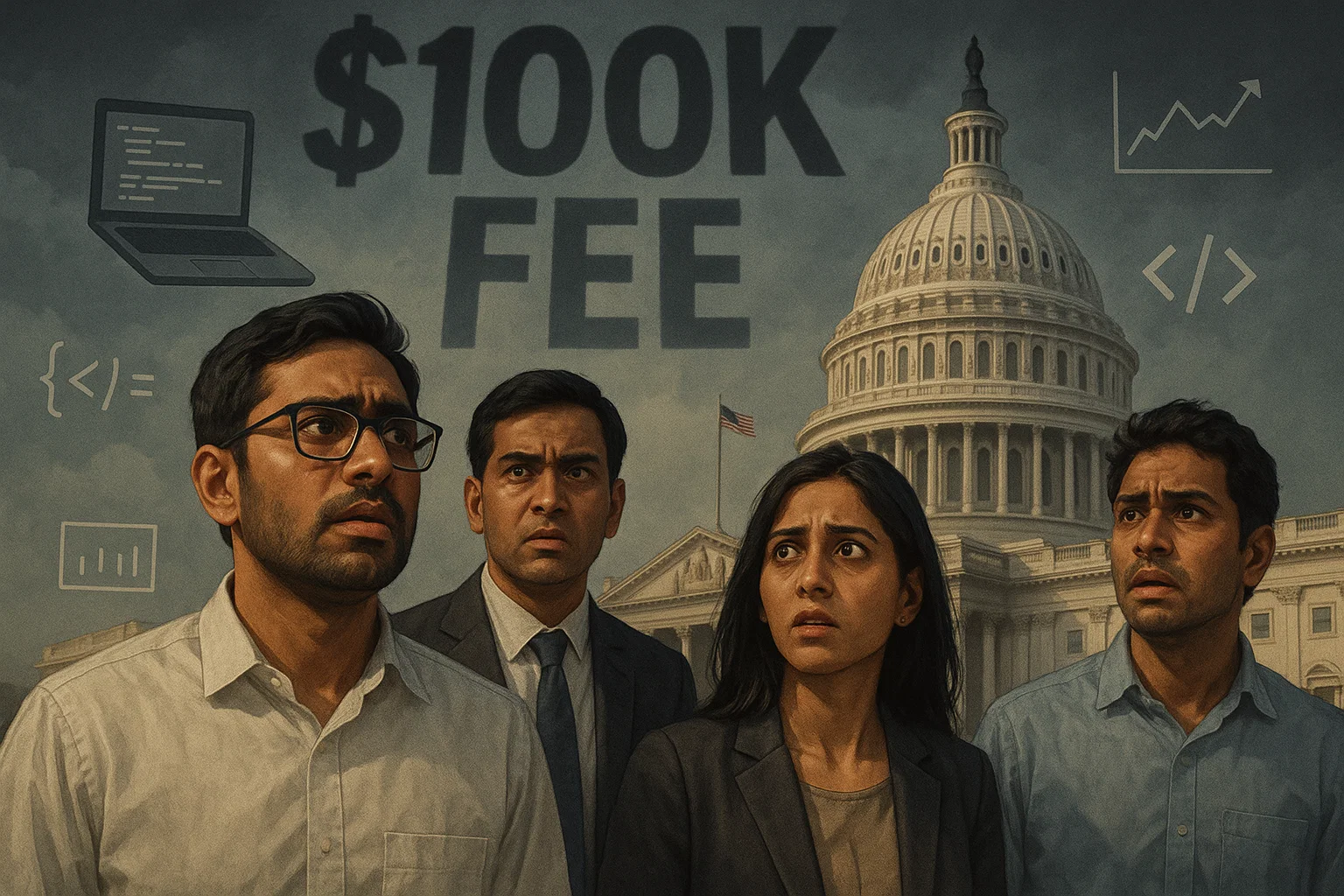
US President Donald Trump announced a shocking hike in H-1B visa fees to $100,000, sending shockwaves through the global tech and business community.
For Indian professionals, the news hit particularly hard. Indians account for over 70% of all H-1B visa holders, and for decades, this program has been their primary pathway to building careers in Silicon Valley and beyond.
The sudden proclamation bypassed traditional rule-making processes and caught employers and employees off guard, leaving families anxious and businesses questioning their next steps.
With court challenges looming and little clarity on whether the move will stand, thousands of Indian workers now face a cloud of uncertainty over their American dream.
To understand what this could mean for professionals and companies alike, Invezz spoke with Sukanya Raman, Senior Immigration Attorney at Davies & Associates, who specializes in US business and investor visas.
Excerpts:
Invezz: How do you see the immediate impact of the proposed H-1B visa fee hike, and how can Indian professionals navigate this change?
Sukanya Raman: The sudden proclamation has thrown the entire H-1B community into chaos.
It says that unless a case is backed by a $100,000 fee, H-1B visa holders won’t be allowed to enter or re-enter the US.
This isn’t the usual process, since we normally see visa fee adjustments come through USCIS or DHS after proper review.
What we have here is an executive proclamation, which came unexpectedly and has left thousands of professionals and their families distressed.
At the moment, people inside the US on H-1B or dependent H-4 visas are being advised not to travel internationally because if they step out, they may not be allowed back in without paying this astronomical fee.
Those stuck outside, even with valid visas, are being told to return quickly. Until there’s legal clarity or a court challenge, the uncertainty is simply devastating for Indian workers who have tied their futures to the program.
Invezz: Are there any alternative visa options Indian professionals can consider to work in the US?
Sukanya Raman: Yes, there are a few. The most practical one right now is the L-1 visa, which is meant for intra-company transfers.
Unlike the H-1B, the L-1 doesn’t come with an annual quota cap; the H-1B is limited to 85,000 a year, which makes it highly competitive.
This gives the L-1 some advantages, especially for multinational companies that want to move their employees between overseas and US offices.
For Indian professionals, many of whom are employed by IT services and consulting giants with global footprints, the L-1 could be an effective alternative.
The eligibility depends on whether you’ve been working at an overseas branch and on your role; managers, executives, and those with specialized knowledge typically qualify.
It won’t work for everyone, but for large firms looking to bypass the H-1B bottleneck, this could help keep talent flowing during an uncertain period.
Invezz: What are the likely consequences for US companies that rely heavily on Indian H-1B professionals given this fee hike?
Sukanya Raman: The US government’s stated intention here is to push companies into hiring more American workers.
But for businesses, especially in industries like technology, healthcare, and engineering, the reality is complicated.
Many of them cannot run efficiently without highly skilled H-1B professionals.
Adding a $100,000 entry fee per worker effectively prices out small and mid-sized firms and forces even the biggest employers to rethink staffing. It’s not just the cost; it’s the unpredictability.
Companies like predictability when it comes to talent and hiring, and that’s exactly what this policy disrupts. I think we’ll see lawsuits soon, because many will argue this is not a legitimate fee but rather an unjust financial barrier.
Invezz: In your experience, will H-1B hopefuls begin to look toward other countries instead of the US?
Sukanya Raman: I think many already are. Canada, for instance, has positioned itself as a clear alternative with its fast-track immigration programs and friendlier policy environment for skilled workers.
The UK is also attracting people through its Global Talent and Skilled Worker visa routes, which are gaining popularity because they’re easier to navigate and less volatile than what’s happening in the US right now.
Beyond that, countries like the UAE, with its growing role as a business hub, and several European nations are opening doors for high-skill foreign talent.
For Indian professionals who traditionally had their eyes set on the US, this visa shock is a wake-up call.
If the path to America involves uncertainty and unaffordable costs, then alternatives like Canada or Europe start looking much more appealing, and employers, too, will reconsider which countries they expand into.
Invezz: Do you think this move will reshape US hiring strategies, perhaps towards automation, offshoring, or domestic talent sourcing?
Sukanya Raman: Yes, absolutely. In fact, that seems to be the government’s aim: to make companies prioritize domestic hiring.
But practically speaking, the short-term fallout will be mixed. Some employers will look to automation to fill gaps, especially in repetitive technology-related functions where AI and machine-learning tools are rapidly advancing.
Others may accelerate offshoring, moving entire departments to countries where the right skill sets are widely available at lower costs, such as India or Eastern Europe.
And of course, there will be a bigger push to tap into domestic talent pools, but here the question is whether the US can generate enough high-skilled workers quickly enough to fill that gap.
So yes, hiring strategies will shift, but the real picture will probably be a blend of automation, outsourcing, and selective domestic hiring rather than a clean switch as policymakers may be hoping.
The post Interview: how Indians can navigate H-1B visa fee hike, immigration attorney Sukanya Raman explains appeared first on Invezz