
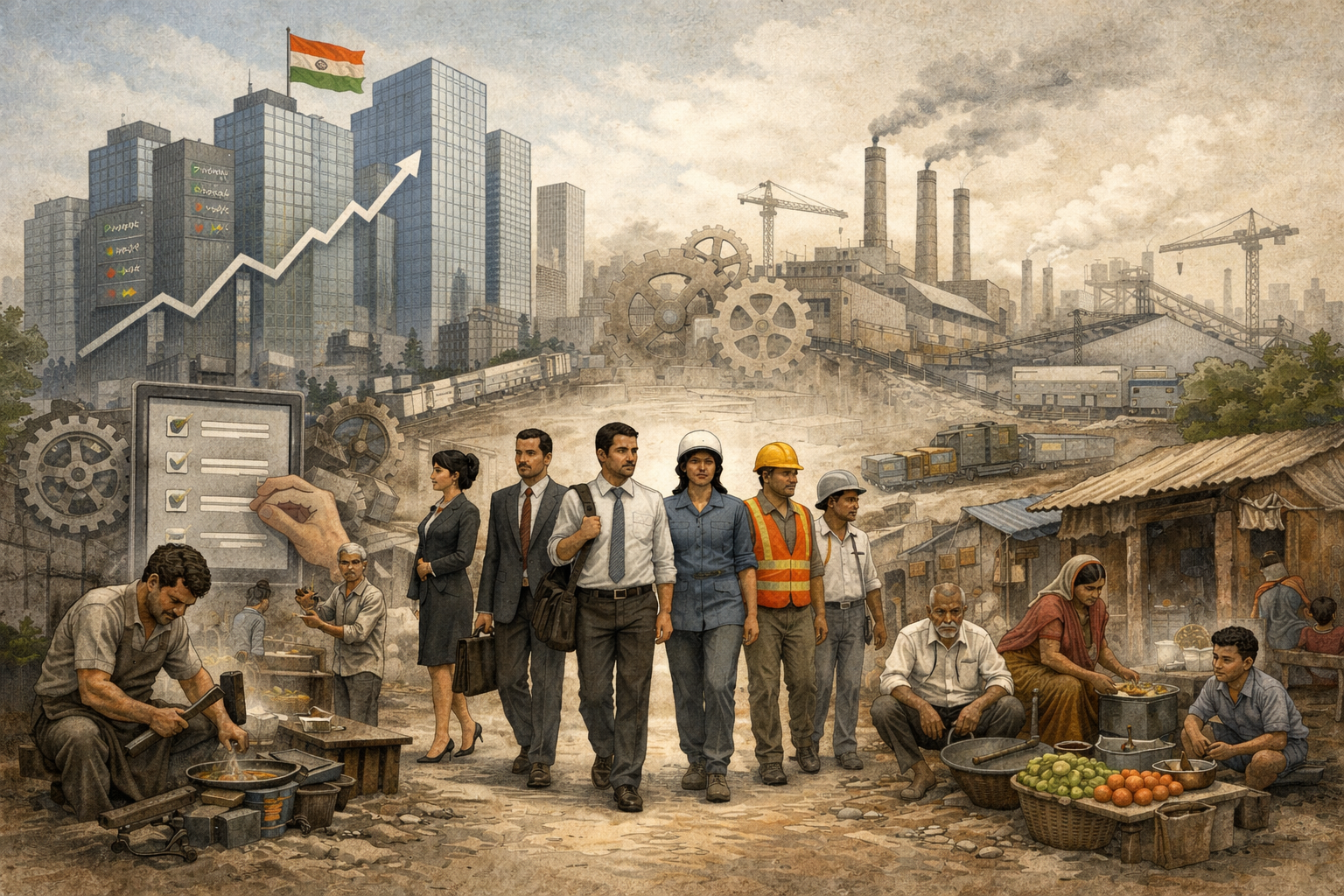
India’s economy has a strange habit of confusing everyone at once.
Growth numbers look strong, stock markets keep attracting attention, and foreign investors are paying attention again.
But this is not the story of the average Indian citizen. Hundreds of millions still live close to the edge, and India’s middle class looks thinner than it should for a country of its size.
This contradiction has become the central test of whether India’s latest reform push actually changes daily life or only reshuffles money at the top.
India’s growth numbers hide a distribution problem
By headline metrics, India is doing well. It has been the fastest-growing major economy for most of the past decade.
Recent quarterly growth has been above 8 percent.
The International Monetary Fund expects about 6.6% growth in fiscal year 2025 to 26 despite a hostile global trade backdrop.
But growth averages hide structure. According to the World Inequality Report cited in a recent Bloomberg analysis, India has not produced a large global middle class the way China has.
Wealth is tightly concentrated. Roughly the top 1% own about 40% of personal wealth.
At the other end, around 800 million people still depend on free food grains. Between these extremes sits a narrow band of salaried households carrying much of the tax burden and consumer demand.
The core issue is not output, but how people earn money. Three-quarters of non-farm workers remain informal. Wages are low. Returns to education are weak by international standards.
For many young Indians, an extra year of schooling adds less to income than in China or even parts of Sub-Saharan Africa.
Perhaps this is not a problem about growth, but one about transmission.
A focus on finance and consumption
This helps explain why India’s government has turned so aggressively toward financial reform.
In late 2025, lawmakers approved rules allowing up to 100% foreign ownership of insurance firms.
Pension funds and capital markets are being opened further.
The stated goal is that India needs long-term capital to build factories, power grids, roads, and industrial corridors.
But domestic savings remain locked in gold and property, and banks alone cannot fund an industrial push at India’s scale.
Insurance and pensions bring patient money that can stay invested for decades.
Japan’s large financial groups, for example, have already moved in with multi-billion dollar deals.
Net foreign direct investment more than doubled year on year in the first half of the fiscal year, according to data from the Reserve Bank of India.
These reforms are indeed significant, but finance is neutral by nature. It can fund jobs or inflate assets.
Without pressure on where money goes, deeper capital markets can widen inequality as easily as they can close it.
Alongside finance, India has taken a turn toward supporting consumption. GST rates were cut on many everyday goods.
Income tax changes lifted take-home pay for middle-income households.
The central bank delivered about 100 basis points of rate cuts over 2025. Home loan payments fell. Car sales jumped by more than 15% year on year in October.
This is not a stimulus for its own sake. It is insurance. After the United States imposed tariffs of up to 50% on Indian goods, policymakers accepted that exports alone cannot carry growth.
A large domestic market must act as a shock absorber.
Consumption support stabilises growth. It does not transform it. That task has been handed to labour reform.
Labour reform and the missing middle class
In November 2025, India enacted four consolidated labour codes covering wages, industrial relations, social security, and worker safety, and the numbers behind them are striking.
More than 1,400 rules were cut to about 350. Dozens of forms and registers were merged and digitised. Inspectors were redefined as facilitators.
For years, India’s labour system encouraged firms to stay small to avoid compliance.
Small firms mean low productivity.
Low productivity means low wages.
The new codes aim to break that loop by making it easier for firms to scale and hire formally.
One clause stands out. Women can now work night shifts in many sectors. This sounds minor, but it is not.
Every major manufacturing boom in Asia began with women moving from farms into factories. India’s female labour force participation remains among the lowest in the developing world.
Unlocking that workforce would raise household incomes, expand the urban middle class, and change consumption patterns in ways no tax cut can match.
The labour codes are the most direct attempt in decades to fix India’s wage problem. Their impact will depend on enforcement and clarity. But the intent is hard to miss.
Can India actually industrialise at scale
Sceptics argue India missed the manufacturing bus. Manufacturing is only about 13% of GDP. Services dominate. But this low share also signals room to grow.
Recent data suggest early movement. Corporate investment announcements reached a decade high in mid-2025, led by manufacturing.
Electronics exports are rising fast. Apple now makes most US-bound iPhones in India and is exploring local component and chip packaging work.
That step matters because assembly creates jobs, and components create skills, suppliers, and wage ladders.
India does not need to copy China’s old model. It needs enough labour-intensive industry to pull workers out of informality and enough capital deepening to raise productivity over time.
Contrast between stock market earnings vs real wage earnings
India’s stock market has been one of the strongest performers among major economies, which says a lot about how growth is perceived.
Over the past five years, the Nifty 500 has delivered total returns of more than 120%, outperforming most global benchmarks, including the S&P 500.
This rally reflects real strengths. Corporate profits have grown faster than wages. Balance sheets are cleaner than a decade ago.
Financials have benefited from credit growth and consolidation. Infrastructure spending has supported capital goods and construction-linked stocks.
For investors, India looks like a country finally turning scale into earnings.
But stock market success highlights a deeper imbalance. Equity ownership in India is still heavily concentrated.
Direct participation remains limited to a small slice of households, while institutional investors and wealthy individuals capture most of the gains. Rising indices therefore, signal confidence in corporate India, not rising prosperity for most workers.
The contrast is sharpest in labour-heavy sectors. Informal employment remains widespread even as listed companies post record profits. Wage growth has lagged profit growth.
Education premiums remain weak. In effect, India’s stock market has priced in reform momentum faster than the labour market has felt it.
Put together, India’s 2025 reforms reveal a clear bet. Growth alone is not enough. Capital must be cheaper.
Firms must be able to scale. Domestic demand must protect against trade shocks.
Capital must also flow into factories now. This will multiply wages, boost education, and consumption. That is how a middle class forms.
The post How India’s strong economic growth is leaving its middle class behind appeared first on Invezz